Charlestown, Warners Bay, Speers Point, Belmont & Valentine
Solar on the foreshore side.
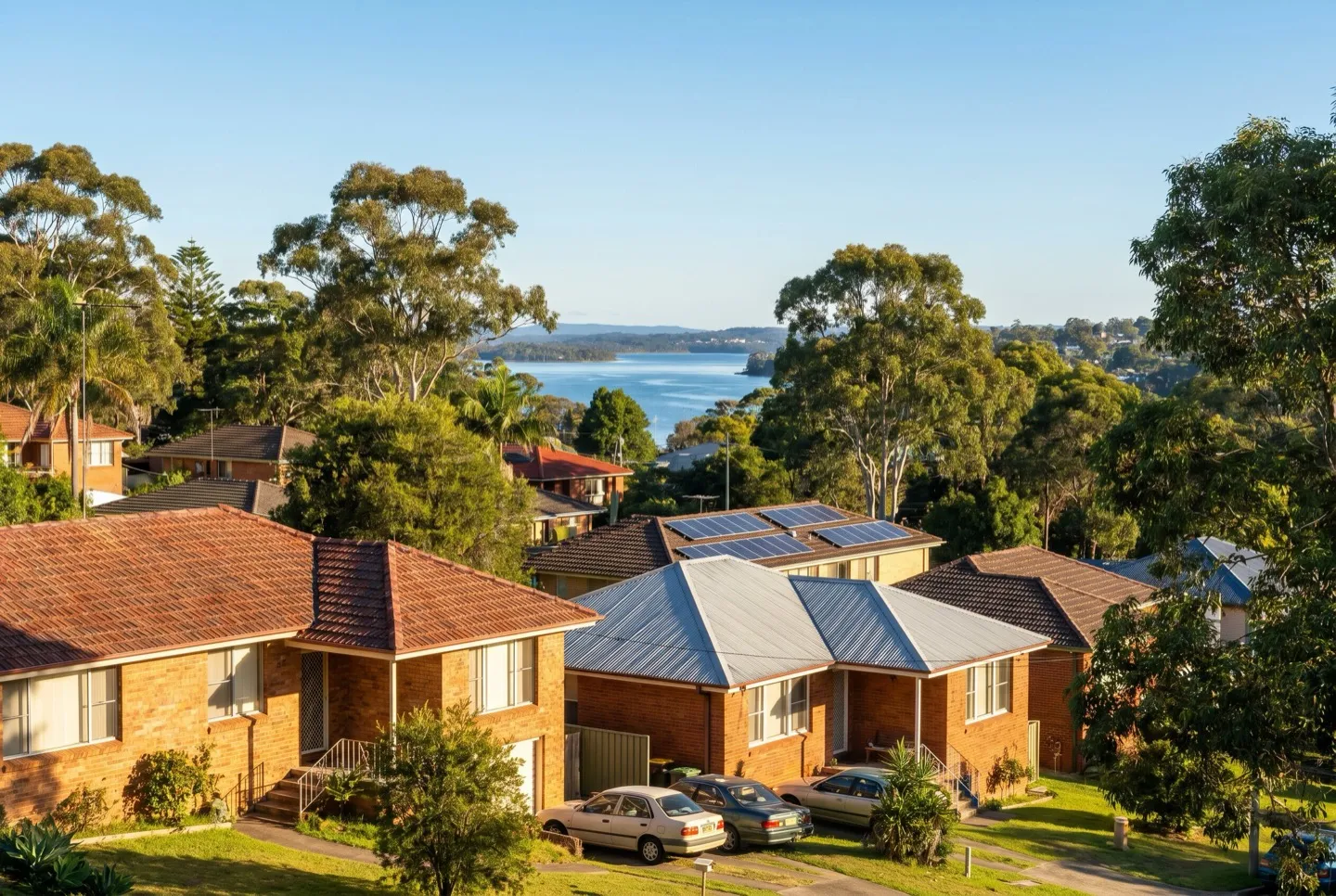
Up on the ridge and down along the water, the northern Lake Macquarie suburbs are their own kind of roof: established brick-and-tile homes on real blocks, close enough to the lake that the hardware spec matters, on a network that's single-phase here and three-phase there. Good solar country, once you read it properly.
~80%separate houses across the Charlestown area, real roof space, owner-controlled (ABS Census)
103 mCharlestown sits up on the ridge, well above the lake foreshore below it (G-NAF elevation)
Single & three-phasethe network is a genuine mix here, it shapes how big a system you can run
A third kind of Newcastle roof
If New Lambton is leafy tile-and-shade and Fletcher is wide new Colorbond, Charlestown and the Lake Macquarie foreshore are a third story again. These are established mid-century brick-and-tile homes on generous blocks along streets like Charlestown Road, Alexander Parade and Algona Road, sitting on the ridge that looks down over the water. Charlestown is in the City of Lake Macquarie, not Newcastle City, but it's the same sun, the same Ausgrid network, and the same honest approach.
For solar, the good news comes first: this is exactly the housing stock solar was made for. Around four in five homes across the Charlestown area are separate houses, and most are owner-occupied (ABS Census, Charlestown-Dudley area), which means real, owner-controlled roof space rather than a shared strata roof you can't touch. The two things worth understanding here aren't about sunshine at all. They're about the lake, and about your power supply.
Does living near the lake change the hardware?
Sometimes, yes, and it's a fair question rather than a scare. Australian solar mounting is specified against atmospheric corrosivity zones (AS 4312 and ISO 9223, referenced in Clean Energy Council installation guidance). The rule of thumb the industry uses: the closer a home sits to the coast or a large body of salt water, the higher the corrosion category, and the more likely the fixings are specified in marine-grade 316 stainless rather than the standard grade used further inland. Immediate beachfront is the most demanding; a couple of kilometres back it eases off.
What that means around here is genuinely varied. Charlestown itself sits high on the ridge and well back from the water, so it usually reads as a standard inland spec. A home right on the lake entrance at Belmont is a different conversation. We don't publish a corrosion rating for your address off a webpage, because it depends on exactly where you are and which way the weather comes from. We confirm it standing at your place.
If you want the full picture of how salt air and the AS 4312 corrosion standard actually work, and how the spec shifts from the open surf coast back to the inland suburbs, we've written it up in Salt air and your solar, complete with a coast-to-bush cross-section and the one question worth asking any installer.
How far above the water? Each of these foreshore suburbs sits at a real, measured elevation. The higher and further back from the lake, the more likely a standard inland fixing is fine; the lower and closer to the water, the more likely marine-grade 316 stainless is specified. It's a tendency, not a rating, and it's always confirmed on site.
Elevations are real ground-height figures from G-NAF address data (Belmont 4.3 m, Warners Bay 16.6 m, Speers Point 25 m, Valentine 30.8 m, Charlestown 102.9 m). The corrosion-zone principle follows Clean Energy Council installation guidance and the AS 4312 / ISO 9223 atmospheric-corrosivity method. No zone rating is shown for any individual address, because that's a judgement made on site. Nothing here is a price.
Can I get the system size I want? Single vs three-phase
This is the second thing the foreshore suburbs throw up, and it's a real one. Your home is fed either single-phase or three-phase, and that sets a ceiling on how much solar you can export back to the grid. On Ausgrid's network, a single-phase home can export up to 10 kW, while a three-phase home can export up to 30 kW (Ausgrid solar connection rules). For most households a single-phase limit is plenty, but if you're planning a big system, a battery, ducted air-con and an EV all together, the phase you're on genuinely matters.
The catch around Charlestown is that it's a mix, not a clean split. Older mid-century streets are often still single-phase, while newer infill and townhouse builds nearby are three-phase-fed, and the two sit side by side on the same block. Upgrading from single to three-phase is a real project with a real network cost, not a formality, so it's never something we assume for your street. We check what you actually have, and design to it.
None of this is a reason to hold off. It's the opposite: it's exactly why a look on the day beats a number over the phone. We'd rather design a tidy system that suits your roof, your spec and your supply than promise you a size your street can't carry.
And the sun itself?
No surprises there. The Lake Macquarie foreshore sits in the same Hunter solar band as the rest of Newcastle, around 4.5 to 5 peak sun hours a day across the year (Bureau of Meteorology solar-exposure data). The foreshore's difference is never about how much sun it gets. It's about the roof, the hardware and the supply, which is the whole reason this page exists.
Nearby and also covered: Charlestown, Warners Bay, Speers Point, Belmont, Valentine, Eleebana, Mount Hutton, Gateshead and Whitebridge. The whole northern Lake Macquarie foreshore shares this ridge-and-water roof story.
Ridge or waterfront, let's read your roof properly.
We'll confirm your corrosion spec, your phase and your export limit on the day, then design a system that actually suits your place. Free, no obligation, no invented numbers.